My Role
UX Research
Tool
Interview
Research type
Qualitative Research, Moderated Research




Context & research questions
Why do some people refuse to adopt online exercising?
To understand this, I conducted user interviews with a segment of people in their 30s who exrcise and don’t do any of their exercise online. The purpose was to gain insights for the product team that could decrease skepticism and increase satisfaction with online exercise.
Research questions
What are the mental models this population relates to exercise at the gym?
What prevents this population from exercising online?
What is important for this population in online exercise?
How can we encourage this population to use online exercise platforms?
“What I dislike about the gym? sometimes it’s too crowded then you don’t have convenient access to the open space”.
Hila, 33
Method
In depth qualitative interviews
Interviewing is an art. You have to listen more than you talk, so it’s best to ask short and open questions. It’s about listening deeply and probing at the right time.
With these (and more) principles and in light of the research questions, I designed the interview. The questions I asked were about the participants’ background, exercise and gym routine, likes and dislikes regarding the gym and more. The full interview can be found upon request.
Analysis
Thematic analysis: from raw interviews to actionable insights
To extract the insights from the interviews, I applied thematic analysis: grouping what participants said into repeating patterns, so the raw conversations became clear, actionable insights. First, I coded raw data - highlighted recurring words and phrases in the transcripts. Then, I grouped these codes into categories that could yield actionable insights.
“I developed my gym routine with my personal trainer, Kobi. He is my source of information.”
Omer, 36
Three steps analysis process
Step 1
Capture raw data
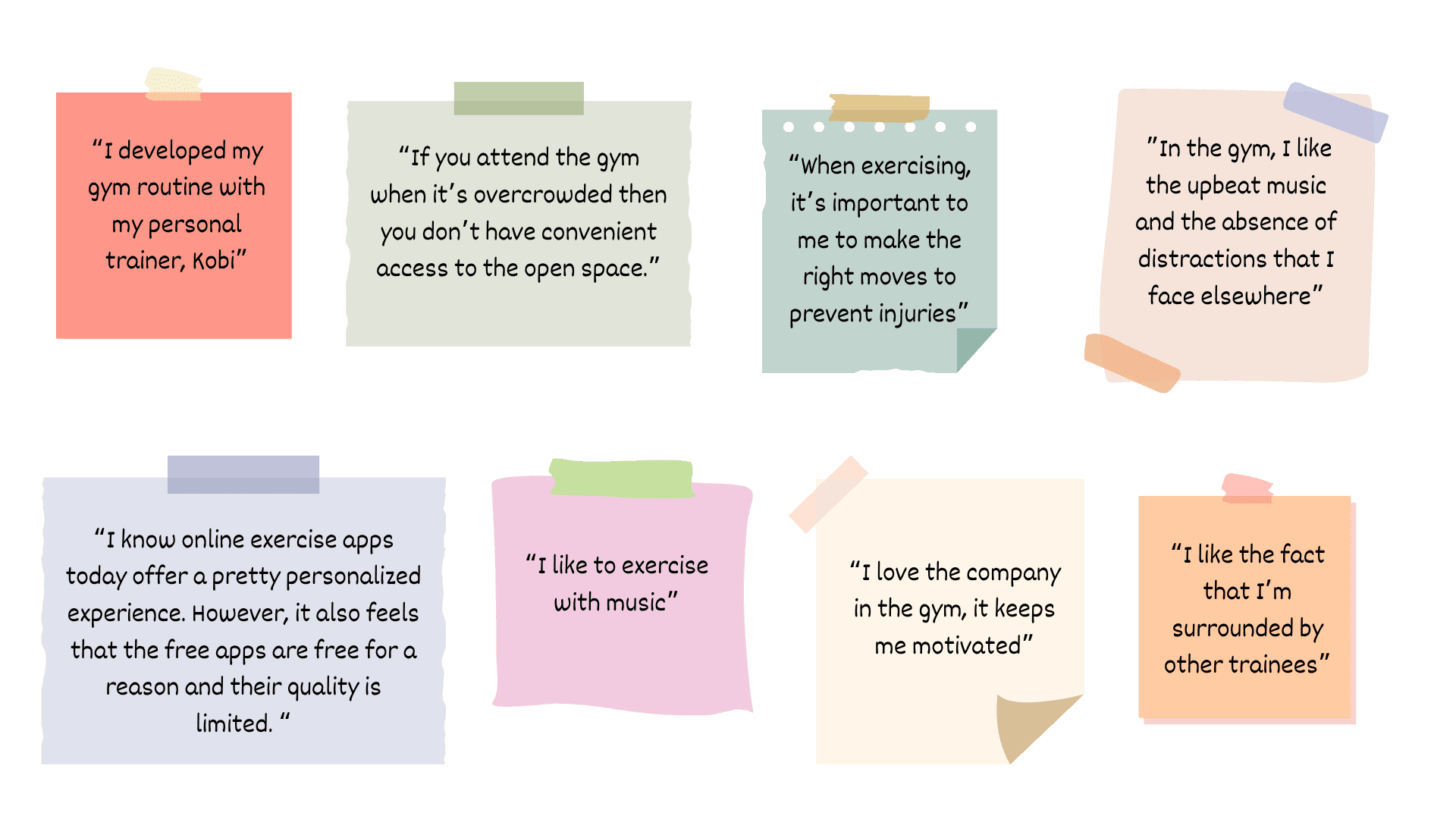
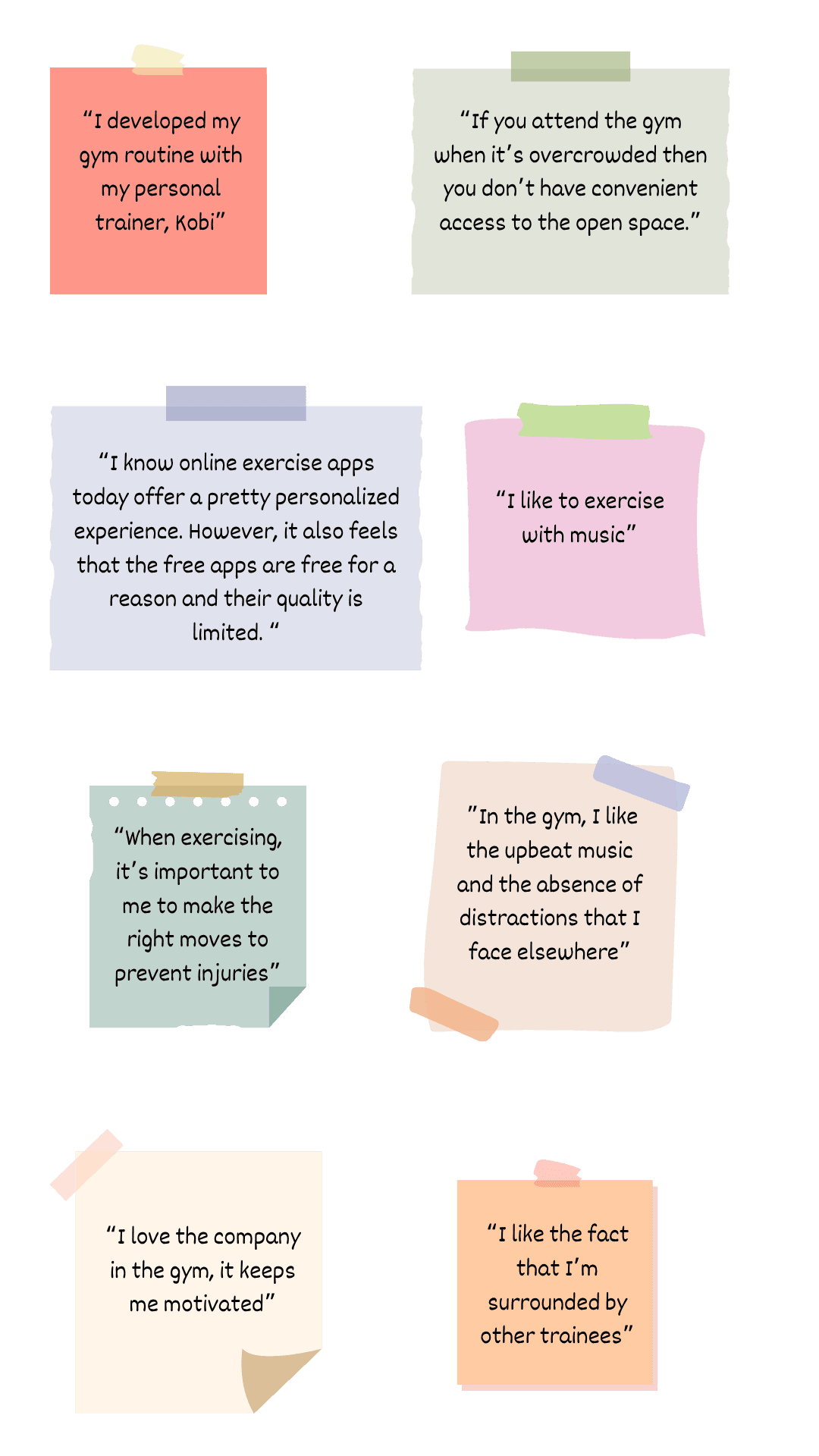
Each note represented a user quote. Then, I laid out the notes and looked for recurring motives: this is the reasoning part of thematic analysis - turning raw data into structured one.
Step 2
Spot similarities, cluster into themes
Each note represented a user quote. Then, I laid out the notes and looked for recurring motives: this is the reasoning part of thematic analysis - turning raw data into structured one.
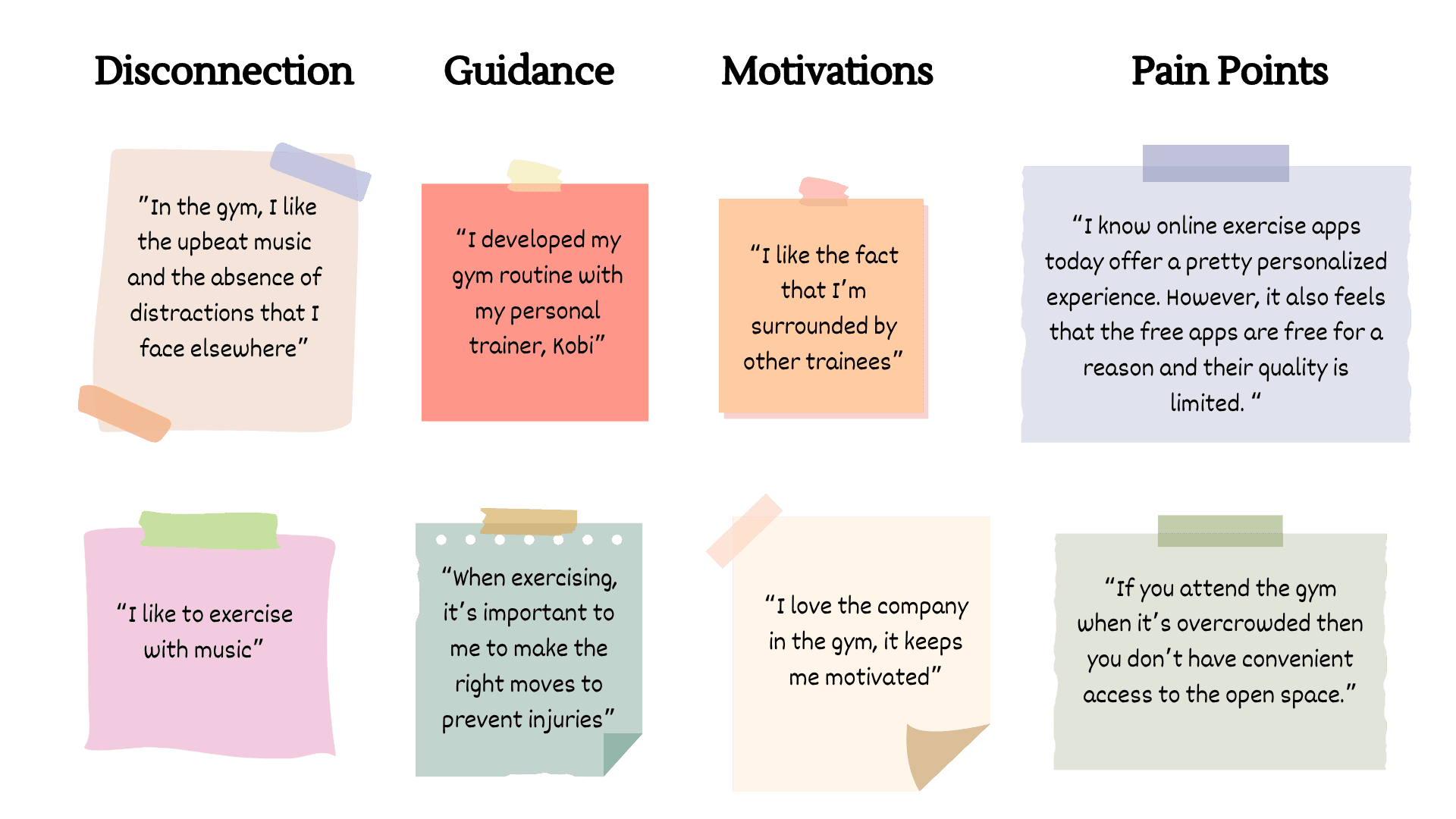
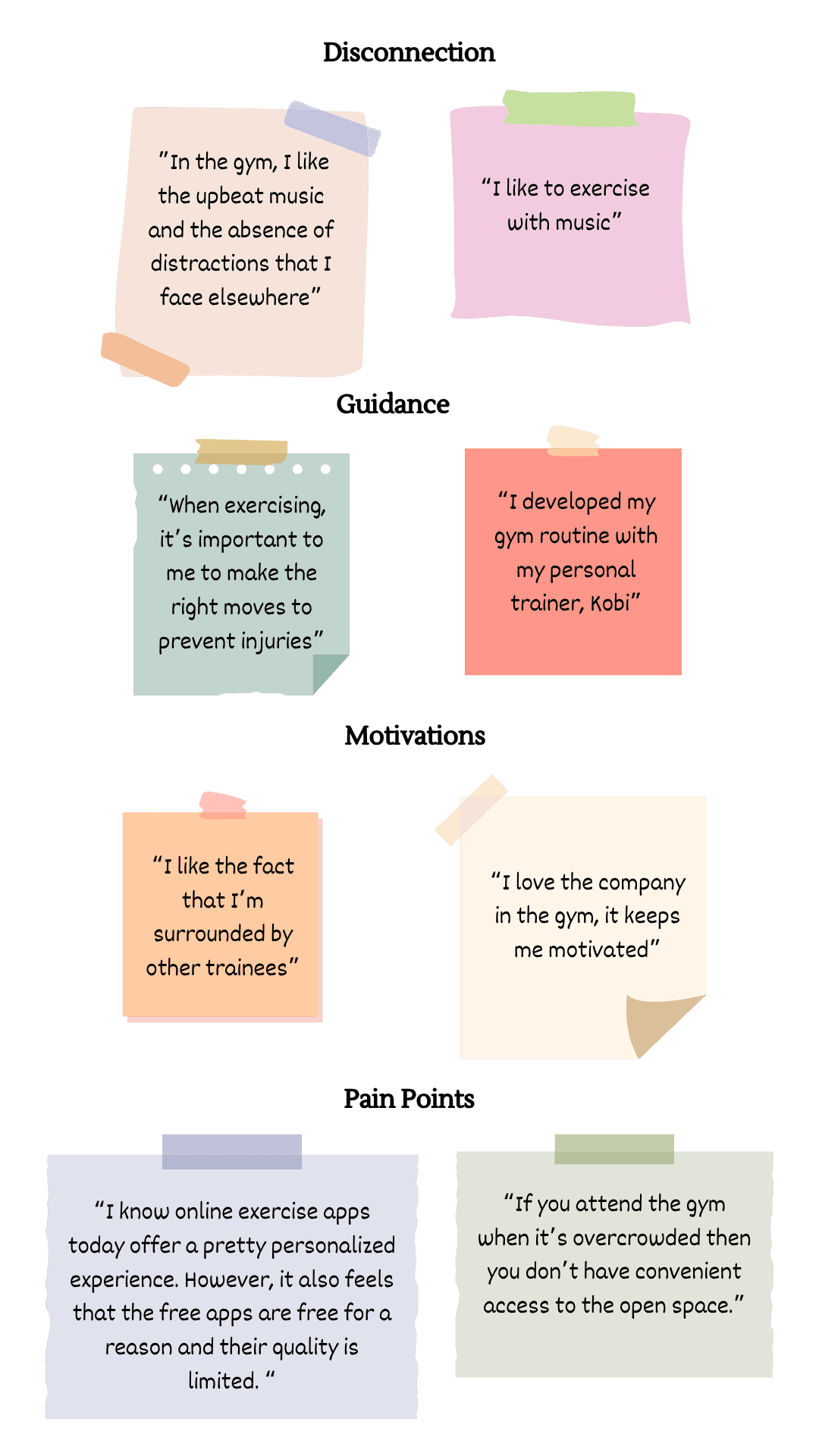
After capturing 30+ user quotes on digital stickies, I conducted thematic analysis: grouped related quotes into themes that captured users’ needs, motivators, and pain points.
Step 3
Translate themes into insights & recommendations
From these categories, I extracted 6 themes and translated them into insights. I reframed the themes into actionable insights and product recommendations
Why do people go to the gym?

A virtual one can help to build a routine, correct movements and provide real-time answers

Disconnecting from the routine and being distractions-free should be emphasized when communicating with this population

A geo-location-based friends and neighbors' feature should be considered
Recommendations


A feature that shows how busy the gym is might be useful

"I love the gym’s atmosphere, whether it’s the music or absence of distractions.”
Renana, 32
Reflection
From quotes to insights
This project showed me how behavioral resistance isn’t about features alone: it’s about identity, routine, and context. By understanding people’s deeper needs, product teams can design online experiences that resonate with offline habits.
I’ve also learned that even small set of interviews can lead to powerful insignts when analyzed systematically. Using thematic analysis, I learned how to move from raw, messy quoted to structured, actionable insights. The process reinforced that interviewing is not simply about collecting stories - it’s about knowing to probe deeper and interpret patterns.